Visisipy: open and accessible vision simulations in Python
Haasjes, Harrison and Beenakker
Research Topics
Abstract
Purpose: Optical ray tracing simulations have become an important tool to study the optical properties of the human eye, but require extensive knowledge of optics and commercial simulation software. Visisipy (VIsion SImulationS In PYthon) is an open-source toolbox that aims to make these simulations more accessible to clinicians and scientists by providing a uniform interface to create optical eye models using clinical measurements and perform ophthalmic analyses on these models.
Methods: Ray tracing results, central and peripheral refraction values, point spread functions and cardinal points from earlier visual optics simulation studies were accurately reproduced with Visisipy. Differences between cardinal points, single ray traces, optical path difference (OPD) maps, spherical equivalent and Zernike coefficients for 27 subject-specific eye models were calculated using the OpticStudio and the open-source Optiland ray tracing backends.
Results: Maximum differences between the two ray tracing backends were 0.495 nm for the cardinal points, 0.666 pm for ray tracing, 2.68×10⁻⁹ waves for OPD maps, 2.79×10⁻³ μm for Zernike coefficients and 1.60×10⁻² D for the spherical equivalent of refraction.
Conclusion: Visisipy makes optical ray tracing simulations more accessible to clinicians and researchers by defining eye models in terms of clinically relevant parameters, providing a set of ready-to-use ophthalmic analyses, and using open-source software. It facilitates standardized visual optics simulation methods, which improves the reproducibility of visual optics simulation studies.
Open Resources
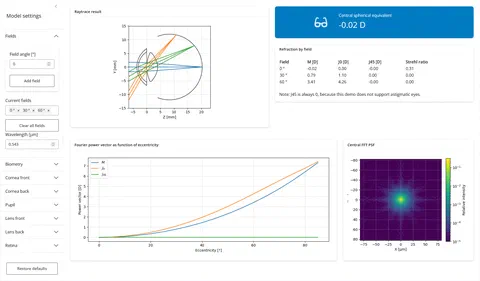
Open Materials: We published Visisipy open-source on GitHub, with documentation and an online demo in which you can run eye simulations in your browser.