Clinical outcomes and risk factors for local failure and visual impairment in patients treated with Ru-106 brachytherapy for uveal melanoma
Pors, Marinkovic, Deuzeman, Vu, Kerkhof, Wieringen-Warmenhoven, Rasch, Bleeker, Koetsier, Beenakker, Luyten, Creutzberg and Horeweg
Research Topics
Abstract
Background: and purpose Small uveal melanomas are preferably treated with eye-sparing therapies such as brachytherapy or proton beam therapy. Knowledge of clinical outcomes and risk factors is important for personalized patient counselling.
Materials and Methods: Data of all choroidal melanoma patients treated at the Leiden University Medical Center between 2012–2019 with Ruthenium-106 brachytherapy were collected. Time-to-event analyses were performed with the Kaplan-Meier method, risk factors for local failure and visual acuity (VA) decline were identified using Cox proportional hazards models with predefined covariates.
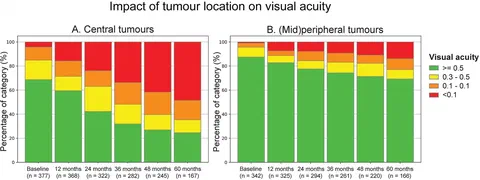
Results: 719 patients were included. Median tumour prominence and diameter were 3.8 mm and 11.6 mm, respectively. 52 % of tumours were centrally located, and 19 % were juxtapapillary. Five-year overall survival, eye retention and local failure rates were 83 %, 95 %, and 8 %, respectively. Juxtapapillary location, lower tumour apex doses, and T3-4 tumour stage were significantly associated with local failure. Patients with juxtapapillary tumours had 20 % risk of local failure. Five years posttreatment, 47 % of patients had no functional visual impairment (Snellen VA ≥ 0.5). Lasting functional visual impairment was associated with baseline vision, central tumours, and scleral dose. Patients with central tumours had 75 % risk of mild or worse visual impairment after 5 years.
Conclusion: Ruthenium-106 brachytherapy yields good local control and visual outcomes in patients with choroidal melanoma. Juxtapapillary tumours have a high risk of local failure and alternative therapies should be considered in these patients, if available. Patients with central tumours, and those with decreased pre-treatment vision should be counselled on the risk of visual impairment.