9.4T and 17.6T MRI of Retinoblastoma: Ex Vivo evaluation of microstructural anatomy and disease extent compared with histopathology
Jong, Graaf, Pouwels, Beenakker, Jansen, Geurts, Moll, Castelijns, Valk and Weerd
Research Topics
Abstract
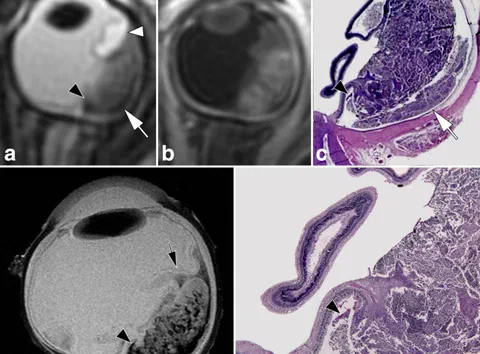
Purpose: Retinoblastoma is the most common intraocular tumor in childhood with a good prognosis in terms of mortality, but detailed information about tumor morphology and disease extent is important for treatment decision making. This study aimed to demonstrate ultrahigh‐field MRI tumor morphology and tumor extent in retinoblastoma by correlating in vivo and ex vivo images with histopathology.
Methods: In this prospective case series, six retinoblastoma patients (median age 5.5 months, range 2–14) were prospectively included. Median time between diagnosis and enucleation was 8 days (range 7–19). In vivo pre‐enucleation imaging was performed at 1.5T with a circular surface coil, and ex vivo imaging (FLASH T1‐weighted and RARE T2‐weighted) was performed at field strengths of 9.4T and 17.6T. After ex vivo imaging, the eyes were histopathologically analyzed and morphologically matched with MRI findings by three authors with ocular MRI and ophthalmopathology expertise.
Results: Small submillimeter morphological aspects of intraocular retinoblastoma were successfully depicted with higher‐resolution MRI and matched with histopathology images. Ex vivo MRI also identified a small subretinal tumor seed (300 μm) adjacent to the choroid and a characteristic geographical pattern of vital tumor tissue (400 μm) surrounding a central vessel interspersed with necrotic areas. Tumor invasion into the optic nerve showed a higher signal intensity on T1‐weighted higher‐resolution MRI.
Conclusion: Higher‐resolution MRI allows small morphological aspects of intraocular retinoblastoma and extraocular disease extent that are not visible on currently used clinical in vivo MRI to be depicted.